Congress Bars Funeral Protesters
WASHINGTON - Demonstrators would be barred from disrupting military funerals at national cemeteries under Legislation approved by Congress and sent to the White House Wednesday.
The measure, passed by voice vote in the House hours after the Senate passed an amended version, specifically targets a Kansas church group that has staged protests at military funerals around the country, claiming that the deaths were a sign of God's anger at U.S. tolerance of homosexuals
Wednesday, May 31, 2006


Godiva
On May 31st, 1678, the Godiva procession through Coventry began.
Godiva (sometimes Godgifu) (c. 980 – September 10, 1067) was an Anglo-Saxon lady, who, according to legend, rode naked through the streets of Coventry in England in order to gain a remission of the oppressive toll imposed by her husband on his tenants.
You can't be surprised that I like this story! Also, for the record.......not all that impressed with the chocolate - Hershey's is better.
Godiva (sometimes Godgifu) (c. 980 – September 10, 1067) was an Anglo-Saxon lady, who, according to legend, rode naked through the streets of Coventry in England in order to gain a remission of the oppressive toll imposed by her husband on his tenants.
You can't be surprised that I like this story! Also, for the record.......not all that impressed with the chocolate - Hershey's is better.
Tuesday, May 30, 2006
1st Annual Milbloggers Shootout
Francis Marion is organizing an event in the Fort Lewis area. It is cross posted over at The Castle. Someone needs to organize a pub crawl for my entertainment.
2,500 Visitors
Sometime today I imagine that I will crack the 2,500 mark. It's pretty funny. One the one hand, I set this up simply to gain the priviledge of commenting on other blogs. So this is a huge number to me. On the other hand, compared with the blogs I visit......it's a tiny number.
******Update*******
Visitor numer 2,500 crossed my threshold today at 1636 EST from Tuscon, Arizona, referred by Blackfive. Didn't stay long, didn't leave a comment....
******Update*******
Visitor numer 2,500 crossed my threshold today at 1636 EST from Tuscon, Arizona, referred by Blackfive. Didn't stay long, didn't leave a comment....
Marines Arrive in Indonesia
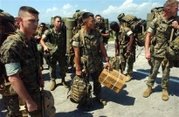
Marines bring supplies for quake victims
BANTUL, Indonesia — Two U.S. military cargo planes landed Tuesday at the site of an earthquake in Indonesia that killed more than 5,400, bringing some of the first significant aid to reach the tens of thousands of survivors who were left homeless.
About 20 U.S. Marines arrived on the cargo planes in the historic city of Yogyakarta and unloaded heavy lifting machinery and a portable field hospital, as Malaysian, Chinese and Japanese rescue workers joined Indonesian teams providing medical care and emergency supplies to victims.
Monday, May 29, 2006
Ok, I Can Be Quiet For A Minute
This is from Military.com.
Moment of Remembrance Hasn't Caught On
Associated Press | May 29, 2006
A tiny White House commission has spent the past five years and $1.5 million trying to bring a new American tradition to Memorial Day's barbecues, parades and sales: A moment of remembrance, a sigh, perhaps a prayer. Just a 30-second pause.
The article is a little whiny and the comments are idiotic, but the idea is important. So I poked around and found the White House Commission on Remembrance
Moment of Remembrance Hasn't Caught On
Associated Press | May 29, 2006
A tiny White House commission has spent the past five years and $1.5 million trying to bring a new American tradition to Memorial Day's barbecues, parades and sales: A moment of remembrance, a sigh, perhaps a prayer. Just a 30-second pause.
The article is a little whiny and the comments are idiotic, but the idea is important. So I poked around and found the White House Commission on Remembrance
Sunday, May 28, 2006
The Dangers of Blogging
No, I am not talking about becoming a pale mushroom because I am addicted to blogging. I am talking about a serious problem - the persecution of bloggers in places where free speech is restricted. Foreign Policy magazine has some interesting information.

Curt Hopkins is founder and executive director of the Committee to Protect Bloggers, a nonprofit organization that works to safeguard bloggers’ rights and monitors the persecution of bloggers around the world.
Some blogs they suggest -
The Zimbabwean Pundit
and
Back Seat Drivers
The article is here.
*********Curt Hopkins has updated some of this information********
Curt said: "I've put the Committee to bed, alas. Just too much burn-out for one guy. But Global Voices Online is preparing an advocacy arm and Amnesty is finally getting in the game (a scant year and a half after Iranian blogges started getting arrested--well, better late then never I suppose); also Reporters Without Borders has an active online arm."

Curt Hopkins is founder and executive director of the Committee to Protect Bloggers, a nonprofit organization that works to safeguard bloggers’ rights and monitors the persecution of bloggers around the world.
Some blogs they suggest -
The Zimbabwean Pundit
and
Back Seat Drivers
The article is here.
*********Curt Hopkins has updated some of this information********
Curt said: "I've put the Committee to bed, alas. Just too much burn-out for one guy. But Global Voices Online is preparing an advocacy arm and Amnesty is finally getting in the game (a scant year and a half after Iranian blogges started getting arrested--well, better late then never I suppose); also Reporters Without Borders has an active online arm."
Sunday At Home
Stuck home today, car is in the shop. I could rent a car. I could borrow Jen's. However, there is lots to do here. So this morning while I cleaned, I listened to some interesting stuff. It's a tiny house, so I can hear the TV everywhere. There is tons to clean because the boys are such slobs. So I started off with "Fox News Sunday". I wonder, does Dick Durbin have a staff member completely devoted to coming up with one incredibly stupid remark after another? Because Durbin is a goofy looking guy with a really goofy smile, so delivery of these lines is no problem. But someone's got to be supplying them. Today's was that we (America) can not possibly even consider building a wall on our southern border with *consulting* with Mexico. What a mutton.
Liz Walker interviewed Ted Kennedy on local TV. He spoke candidly about his religious convictions and his deep faith. **Snort**
Next was The McLaughlin Group......it was just OK.
The most interesting was a two hour debate on Book TV on CSpan. A. C. Grayling has written a book about the Allied targeting of civilians during WWII. "Among the Dead Cities" sounds like a very interesting book. But there is one glaring flaw. Mr. Grayling asserts that if you find 9/11 morally repugnent, and you should then you must feel the same way about Dresden. He strings together Allied bombings of Germany with the IRA, ETA, and Al Qaeda.......Christopher Hitchens ripped him on it. Hitchens states that it's wrong to even string these things together in the same paragraph and I agree. Hitchens discussed the same historical time period and had many interesting insights. I really like listening to him. I wonder if he will visit Boston. But the whole discussion was very interesting.
Liz Walker interviewed Ted Kennedy on local TV. He spoke candidly about his religious convictions and his deep faith. **Snort**
Next was The McLaughlin Group......it was just OK.
The most interesting was a two hour debate on Book TV on CSpan. A. C. Grayling has written a book about the Allied targeting of civilians during WWII. "Among the Dead Cities" sounds like a very interesting book. But there is one glaring flaw. Mr. Grayling asserts that if you find 9/11 morally repugnent, and you should then you must feel the same way about Dresden. He strings together Allied bombings of Germany with the IRA, ETA, and Al Qaeda.......Christopher Hitchens ripped him on it. Hitchens states that it's wrong to even string these things together in the same paragraph and I agree. Hitchens discussed the same historical time period and had many interesting insights. I really like listening to him. I wonder if he will visit Boston. But the whole discussion was very interesting.
Saturday, May 27, 2006
Saturday
I worked today and it was very busy. I leave for the gym soon. There was not a lot of time for surfing today, but I always make time to go to The Castle.
The Armorer has put up another post about his friend's son-in-law, 2LT Leonard Cowherd.
Go read it here. If you didn't read yesterday's post, it is here.
They are incredibly moving and highly appropriate to this weekend.
The Armorer has put up another post about his friend's son-in-law, 2LT Leonard Cowherd.
Go read it here. If you didn't read yesterday's post, it is here.
They are incredibly moving and highly appropriate to this weekend.
Friday, May 26, 2006
Memorial Day
Go over to The Castle and read what the Armorer has to say.
Good job John.
Don't worry about me, you know Princess Crabby takes care of the servicemen in her circle.
Good job John.
Don't worry about me, you know Princess Crabby takes care of the servicemen in her circle.
Hayden's In, I'm Happy
Senate Confirms Hayden As CIA Director
WASHINGTON -- After hearing assurances he will be independent of the Pentagon, the Senate on Friday easily confirmed Gen. Michael Hayden, a career Air Force man, to head the CIA.
Hayden, a four-star general, currently is the top deputy to National Intelligence Director John Negroponte.
I think this will be good.
WASHINGTON -- After hearing assurances he will be independent of the Pentagon, the Senate on Friday easily confirmed Gen. Michael Hayden, a career Air Force man, to head the CIA.
Hayden, a four-star general, currently is the top deputy to National Intelligence Director John Negroponte.
I think this will be good.
The Evacuation of Dunkirk

In 1940, the evacuation of Dunkirk began. Sailing vessels of every kind were pressed into service to ferry across the English Channel the British, French and Belgian soldiers trapped by advancing German forces in northern France. All 200,000 were safely across by June 2.
Remember? Walter Pidgeon left Greer Garson home during that part of the movie. All through school I was very good in history. But I was never better than I was with WWII history because I could picture all the movies. For me, all history revolves around John Wayne, Spencer Tracy, Robert Taylor......
Dinner Last Night
I crashed Jen's dinner last night with some old friends from work. We met at Gaven's in Middleton. It was a very pleasant night, lot's of laughs. It was a steakhouse and the steaks were good. A little pricey for me. They had a lot of catching up to do and it was a pleasant change from the day before when Jen knocked the passenger sideview mirror off of her car.
I was a little intrusive in Jen's life yesterday. I went to dinner anyway. I knew I'd have my head handed to me. C'est la vie. We had fun. Jen needs more fun.
I was a little intrusive in Jen's life yesterday. I went to dinner anyway. I knew I'd have my head handed to me. C'est la vie. We had fun. Jen needs more fun.
Wednesday, May 24, 2006
More Cartoon Riots!!!
This time it's Iranians making fun of Iranians. Who to make fun of? Who to support? Who to boycott? Will Palestinians pull Iranian goods off of shelves? Will Muslims eat danish again? Who knows? Who cares? Not I!
Iran Shuts Down Newspaper Over Cartoon
TEHRAN, May 23 — The government shut down one of its official newspapers on Tuesday for publishing a cartoon that mocked Iran's Azeri minority and led to riots in northwestern cities.
The joke?
The cartoon, published Friday, showed a boy repeating the Persian word for cockroach in different ways, while a cockroach in front of the boy asked "What?" in Turkish Azeri.
Ahhhhhhh! Iranian humor. Those guys crack me up!
Iran Shuts Down Newspaper Over Cartoon
TEHRAN, May 23 — The government shut down one of its official newspapers on Tuesday for publishing a cartoon that mocked Iran's Azeri minority and led to riots in northwestern cities.
The joke?
The cartoon, published Friday, showed a boy repeating the Persian word for cockroach in different ways, while a cockroach in front of the boy asked "What?" in Turkish Azeri.
Ahhhhhhh! Iranian humor. Those guys crack me up!
Ghoulish Hoffa Humor
 MILFORD, Mich., May 23 — The most popular items on the menu at the Milford Baking Company these days are the 95-cent "Hoffa cupcakes" featuring a green plastic hand reaching up through chocolate icing and candy sprinkles designed to resemble dirt.
This story is in the New York Times.
Tuesday, May 23, 2006
Anonymous Misspeaks
Anonymous has commented in a previous post and I must respond. He asserts that his grandfather "Never got the memo." Never got the memo! Thomas, you forget yourself!
You have obviously forgotten about the man in Vegas. Your grandparents were enjoying a Vegas show when there was a commotion at a nearby table. Seated at the table were several women and one man. All of the women began screaming and people thought they saw a mouse. Papa was the only one who noticed the man who was sitting at their table, choking. Papa rushed over........performed the heimlich and saved the man.
Obviously, in your case, Papa decided that pulling the meat out of your mouth was sufficient and it was since you are still walking around annoying me. If you recall, I did something similar to you when you were eating pastrami and to CIE when she was eating spinach.
You have obviously forgotten about the man in Vegas. Your grandparents were enjoying a Vegas show when there was a commotion at a nearby table. Seated at the table were several women and one man. All of the women began screaming and people thought they saw a mouse. Papa was the only one who noticed the man who was sitting at their table, choking. Papa rushed over........performed the heimlich and saved the man.
Obviously, in your case, Papa decided that pulling the meat out of your mouth was sufficient and it was since you are still walking around annoying me. If you recall, I did something similar to you when you were eating pastrami and to CIE when she was eating spinach.
The Squalus
Today in history........The USS Squalus.........
In 1939, the U.S. Navy submarine Squalus went down off New Hampshire in 240 feet of water.
Thirty-three of the 59 men aboard were saved in a daring rescue with a diving bell.
Here's some recommended reading from the Hampton Public Library.
In 1939, the U.S. Navy submarine Squalus went down off New Hampshire in 240 feet of water.
Thirty-three of the 59 men aboard were saved in a daring rescue with a diving bell.
Here's some recommended reading from the Hampton Public Library.
Monday, May 22, 2006
24
The season ender was the balls! Sorry Tom. I have to write about it. Jean Smart as the FLOTUS was excellent. She totally saved the day. I am bummed she didn't get more "quality time" with Agent Pierce.
Rice's Mixed Reception
Secretary Rice at Boston College
Demonstrations planned as Rice speaks at Boston College
BOSTON --Secretary of State Condoleezza Rice was greeted with a polite protest that was quickly drowned out by a standing ovation Monday as she took the podium to speak at the Boston College commencement.
I'm OK with this.
Love this comeback.........
"People have the right to protest, but I hope when they protest they realize also that people now have a right to protest in Baghdad and Kabul, and that's a very big breakthrough for the international community," Rice said in an interview with WBZ-AM.
There was a guy who resigned over this and my favorite Jarhead in Okinawa wrote about it.
Demonstrations planned as Rice speaks at Boston College
BOSTON --Secretary of State Condoleezza Rice was greeted with a polite protest that was quickly drowned out by a standing ovation Monday as she took the podium to speak at the Boston College commencement.
I'm OK with this.
Love this comeback.........
"People have the right to protest, but I hope when they protest they realize also that people now have a right to protest in Baghdad and Kabul, and that's a very big breakthrough for the international community," Rice said in an interview with WBZ-AM.
There was a guy who resigned over this and my favorite Jarhead in Okinawa wrote about it.
I Want To Be Here.......
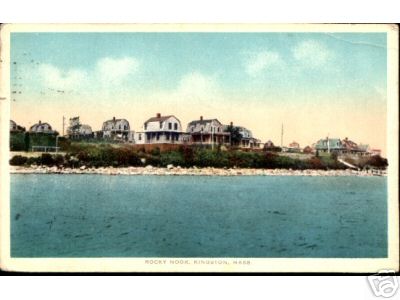
.......instead of work.
I want to be hanging with my sisters on Jen's deck. We would need someone to bring us lunch and serve us drinks. I could get all caught up on my reading.......foreign Policy......Decatur by Robert Allison........Cosmo (shhhh, don't tell anyone).....
Someone will need to make us margaritas and keep Grace's onion dip bowl filled.
Dinner at East Bay Grille........we'll need a driver though.

Sunday, May 21, 2006
Frankie & Toni
Today was Confirmation Day for Frankie and Toni. I was so proud of them. Jen was Frankie's sponser, I was Toni's. It wasn't at St. Francis because for the last few years they've had this Town wide thing and it moves from parish to parish. I didn't luck out with either son, Tom was at St. Mary's. But at least Tom's was orderly. This was chaos. One set of instructions in the hall and a different set in the church. No matter, Bishop McNaughton was great and his talk before the ceremony and his homily were interesting. Father Mahoney was there, it's always so great to see him. I was in the fourth pew and he caught my eye after Communion and winked. My grin was ear to ear....he is so mischievious now that I am an adult. LOL No pics with the Bishop because Frank couldn't stand the wait. All that mattered was that we got the pictures with Father Mahoney. It was a beautiful spring day.
Everyone went back to my parent's house. I am so lucky to have them to host all my parties, lol. I fell off the wagon.....the sugar was such a rush! Jen is mad at me and says she won't go with me to yoga on Tuesday but I will go right back on tomorrow.
We went to Frank's soccer game after that. The skies opened up and it poured! I should have been fine. I had Jen's windbreaker and my Dad's giant umbrella (which he insisted I take because it's *better* than any other).....but Toni & Breanne had nothing so I gave them the umbrella.
I feel much better now. A good, hot shower fixes everything!
Everyone went back to my parent's house. I am so lucky to have them to host all my parties, lol. I fell off the wagon.....the sugar was such a rush! Jen is mad at me and says she won't go with me to yoga on Tuesday but I will go right back on tomorrow.
We went to Frank's soccer game after that. The skies opened up and it poured! I should have been fine. I had Jen's windbreaker and my Dad's giant umbrella (which he insisted I take because it's *better* than any other).....but Toni & Breanne had nothing so I gave them the umbrella.
I feel much better now. A good, hot shower fixes everything!
Saturday, May 20, 2006
McCain
McCain was booed during a commencement speech.
Whiskey Tango Foxtrot!!!!!!!
He's irritated me, but what the hell! How about a little fucking respect.
I am so tired right now.......so I'll just slap the links up.
"New School grads raze McCain's talk"
"Conservative darling Sen. John McCain was harangued by hecklers, booed and even subjected to paper airplanes as he gave the commencement speech for the New School yesterday."
Night.
Whiskey Tango Foxtrot!!!!!!!
He's irritated me, but what the hell! How about a little fucking respect.
I am so tired right now.......so I'll just slap the links up.
"New School grads raze McCain's talk"
"Conservative darling Sen. John McCain was harangued by hecklers, booed and even subjected to paper airplanes as he gave the commencement speech for the New School yesterday."
Night.
Friday, May 19, 2006
Hayden
New York Times - May 19, 2006.......
QUOTATION OF THE DAY
"You get a lot more authority when the workforce doesn't think it's amateur hour on the top floor."
GEN. MICHAEL V. HAYDEN, President Bush's nominee for C.I.A. director.
LOL!
QUOTATION OF THE DAY
"You get a lot more authority when the workforce doesn't think it's amateur hour on the top floor."
GEN. MICHAEL V. HAYDEN, President Bush's nominee for C.I.A. director.
LOL!
Thursday, May 18, 2006
A Break From Our Usual Festivities
I will not be blogging much for a bit. Family business. What little spare time I have will be devoted to following the Hayden business.
No more Baghdad Brief, boo! Although I am happy for MG Rick Lynch because he gets to be back here with us. I wish him every success in the future.........really, really I do. I am just stunned that the Pentagon has failed to realize that's is all about Maggie...........going off to pout now.
No more Baghdad Brief, boo! Although I am happy for MG Rick Lynch because he gets to be back here with us. I wish him every success in the future.........really, really I do. I am just stunned that the Pentagon has failed to realize that's is all about Maggie...........going off to pout now.
Tuesday, May 16, 2006
Jen & I
So we are watching "24". There is a scene where Jack is talking to Henderson (a bad guy).
Jack: How do you know I won't just kill you?
Henderson: Because you'll give my your word. I know what that's worth to you.
Jen and I laugh.....we know too.........Gotcha!
Then I pass Jen an Atkins snack.
Jen: I thought you weren't eating these.
Me: I lie. I always lie.
Jen: So Henderson wouldn't take your word?
She got me!
Jack: How do you know I won't just kill you?
Henderson: Because you'll give my your word. I know what that's worth to you.
Jen and I laugh.....we know too.........Gotcha!
Then I pass Jen an Atkins snack.
Jen: I thought you weren't eating these.
Me: I lie. I always lie.
Jen: So Henderson wouldn't take your word?
She got me!
It's Not Raining Everywhere

Dubai Weather at: 11:00 am GST F° | C°
Currently:
93°
Fair High: 94°
Low: 79°
Monday, May 15, 2006
I Always Have A Plan......
Tonight's plan.........the gym from 1900 hours to 2100 hours then off to see "24" with Jen. But I don't want to miss the President's speech. So after I drop off Trish's computer, I hit Circuit City. I explain that there are TVs at the gym and I need some receiver. The kid keeps trying to sell me an IPod. I keep explaining that I just want to listen to the TV. I finally decide on a model.......buy two.....I owe Trish a birthday present and we are usually together at the gym. Dash home, change, dash to the gym, ask them to change TV #4 to FoxNews (looooove Brit Hume, Bill Kristol, etc.). I am on the treadmill 5 minutes ahead of the speech.........it doesn't work! LOL
I had to call Jen and have her put the phone in front of the TV!
But the steam afterwards was sooooooo worth it!
I had to call Jen and have her put the phone in front of the TV!
But the steam afterwards was sooooooo worth it!
Tonight Was Incredible!
Did you watch "24"....is Agent Aaron Pierce not the best? I called it as soon as we saw him in the chair. I kept saying where is Martha? Jen was laughing at me and telling me to knock it off. Jen asserted that there was *no way* Martha was going to rescue him. She said Pierce was a dead man. I was right!!!!!!! Yea!!!!
Go over to Blogs4Bauer. I had heard of it, but tonight is my first time there. I am kicking myself for not going sooner. One of the contributors is Buckley F. Williams, who I absolutely love over at "The Nose on Your Face".
The opening line is
Liveblogging: 4 AM to 5 AM
8:52 (local time): If you're showing up at 9:00 EST expecting to see the liveblogging and 24 craziness beginning, get out of my country. Only illegal immigrants wouldn't know that the President was speaking tonight on immigration/border control/guest working issues, and everything on Fox is delayed by 20 minutes.
So come back at 9:20, watch 24, read both of our liveblogs, and then hop the border back to your homeland
Go over to Blogs4Bauer. I had heard of it, but tonight is my first time there. I am kicking myself for not going sooner. One of the contributors is Buckley F. Williams, who I absolutely love over at "The Nose on Your Face".
The opening line is
Liveblogging: 4 AM to 5 AM
8:52 (local time): If you're showing up at 9:00 EST expecting to see the liveblogging and 24 craziness beginning, get out of my country. Only illegal immigrants wouldn't know that the President was speaking tonight on immigration/border control/guest working issues, and everything on Fox is delayed by 20 minutes.
So come back at 9:20, watch 24, read both of our liveblogs, and then hop the border back to your homeland
The Chump Line Was In Rare Form Today....
One of the best parts of Howie Carr's radio show on WRKO........is the chump line.
If you are anywhere near me, you know it has been raining...............it feels like 40 days and 40 nights.
This guy calls and says "I know it's just rain right now........but I'm going to go up to the roof and wait for my $2,000 from FEMA!"
LOL
If you are anywhere near me, you know it has been raining...............it feels like 40 days and 40 nights.
This guy calls and says "I know it's just rain right now........but I'm going to go up to the roof and wait for my $2,000 from FEMA!"
LOL
Darwinism
I don't actually see the problem with this. This is just how we keep the gene pool clean. A good filter if you will...............
Report: 48 Million Refuse to Buckle Up
"About 48 million people do not regularly put on seat belts when they are on the road, a figure the government's highway safety agency hopes to lower with an annual public education campaign ahead of the summer driving season."
If those 48 million aren't bright enough to save there own lives....why am I worried? Don't get me wrong, people should be made to strap in children. They should be protected. But adults? Please!
"Those who still don't buckle up need to know that police officers will be aggressively enforcing seat belt laws throughout the country and that violators will be ticketed," said Phil Haseltine, executive director of the National Safety Council's Air Bag & Seat Belt Safety Campaign."
I can think of lots of other places I want the attention of these officers focused.
(No, no, I didn't mean on me...........although that's not a bad thing.)
Report: 48 Million Refuse to Buckle Up
"About 48 million people do not regularly put on seat belts when they are on the road, a figure the government's highway safety agency hopes to lower with an annual public education campaign ahead of the summer driving season."
If those 48 million aren't bright enough to save there own lives....why am I worried? Don't get me wrong, people should be made to strap in children. They should be protected. But adults? Please!
"Those who still don't buckle up need to know that police officers will be aggressively enforcing seat belt laws throughout the country and that violators will be ticketed," said Phil Haseltine, executive director of the National Safety Council's Air Bag & Seat Belt Safety Campaign."
I can think of lots of other places I want the attention of these officers focused.
(No, no, I didn't mean on me...........although that's not a bad thing.)
The OpFor Guys
Any regular reader knows I love John and Charlie (and now Maj.P) over at OpFor. Todays posts inlcude a graphic on how the UN works. Remember, you can't spell unethical without "UN".........
Pop over and see the comments too.

Pop over and see the comments too.

Sunday, May 14, 2006
Happy Mother's Day

I am off to my mother's house laden with flowers and books and chocolates and immense gratitude to the woman who put up with me through many, many, many....many trying years. As you can imagine.........I was a horrid child. Pretty (my mother's friends thought I looked like Darla on The Little Rascals), but horrid.
God Has Spoken
Saturday, May 13, 2006
Major General Rick Lynch

I am sooooooooooooooo upset!!!!! I was listening to the Baghdad Briefing (I started on Thursday when it was live, but missed the end)on the Pentagon Channel. I find Saturdays a good day to catch up.
Anyway, I get to the end of the briefing and he announces that his tour is over! This was his last press conference! What am I going to do? Don't get me wrong I like LtGen Sir Rob Fry, Deputy Cmdr of Multi-National Force-Iraq and LTG Karl Eikenberry, Commanding GEN Combined Forces Command-Afghanistan..........but nobody beats Rick!
Wait Wait Don't Tell Me
is my favorite liberal radio show.
NPR produces Wait Wait Don't Tell Me and while there is a decidedly left wing bent..........it is still funny as hell. It's crack for news junkies like me. If you listen to NPR during the week......and I do.....BBC NewsHour.........Morning Edition.............Talk of the Nation................On Point..........this test of knowledge is fun.
Anyway, today in their story of Patrick Kennedy's car accident the cited the blog of The Anti-Idiotarian Rottweiller.
I've been to this blog on several occassions, but I just lurk. He scares me and I know I never want to catch his eye. Read his post about finding fame at NPR here.
NPR produces Wait Wait Don't Tell Me and while there is a decidedly left wing bent..........it is still funny as hell. It's crack for news junkies like me. If you listen to NPR during the week......and I do.....BBC NewsHour.........Morning Edition.............Talk of the Nation................On Point..........this test of knowledge is fun.
Anyway, today in their story of Patrick Kennedy's car accident the cited the blog of The Anti-Idiotarian Rottweiller.
I've been to this blog on several occassions, but I just lurk. He scares me and I know I never want to catch his eye. Read his post about finding fame at NPR here.
I Need To Figure Out What Is Wrong With Me
I had the whole weekend mapped out. Last night I was late to the gym, late to Jennifer's. This morning I slept through the alarm, missed morning Mass, was late to work. I am behind on the laundry (yes, FbL, Princess Crabby does laundry), behind at work. There are books stacked up in my room I haven't read. Projects I need to tackle.
I am completely lacking in motivation.
I am completely lacking in motivation.
Pop On Over To mAss Backwards
Bruce is having a contest for "Peace Weekend".
We are all terribly jaded.
The object: "This one's easy. All you have to do is guess the number of shootings and stabbings (combined) to occur on the streets of Boston during the upcoming Peace Weekend."
I picked 6. There is a scorecard. If I win I am going to try to get Bruce to hand deliver my prize. He is a funny guy and I wouldn't mind meeting him. Then I could put him on my "Bloggers I Have Met".....if I ever figure out how to add that to this thing.
We are all terribly jaded.
The object: "This one's easy. All you have to do is guess the number of shootings and stabbings (combined) to occur on the streets of Boston during the upcoming Peace Weekend."
I picked 6. There is a scorecard. If I win I am going to try to get Bruce to hand deliver my prize. He is a funny guy and I wouldn't mind meeting him. Then I could put him on my "Bloggers I Have Met".....if I ever figure out how to add that to this thing.
This Day In History
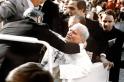
Twenty five years ago today the Pope was shot.
This was the New York Times headline:
Pope Is Shot in Car in Vatican Square; Surgeons Term Condition 'Guarded'; Turk, an Escaped Murderer, Is Seized
2 Bullets Hit Pontiff
Part of Intestine is Removed in 5-Hour Operation
Hand Also Injured
By HENRY TANNER
Special to The New York Times
RELATED HEADLINES
Made Threat In '79: Alleged Assailant Wrote a Letter Saying He'd Kill John Paul on Trip
A Firm Papacy For the People: Pope Strives to Deliver His Message Worldwide
Infection Is Main Risk In Pontiff's Recovery; New Surgery Required
Amid Prayers, World Voices Its Indignation
For New York, Tearful Memories
ROME, Thursday, May 14 -- Pope John Paul II was shot and seriously wounded yesterday as he was standing in an open car moving slowly among more than 10,000 worshipers in St. Peter's Square
The rest of the article is here.
Most of the things I post about in the "This Day in History..... are not things I lived through. This was different. I was 20 and remember this vividly. I was always torn over the fact that the Pope forgave Mehmet Ali Agca. Yet, how could he do otherwise? People always surprise me when I view them through the prism of my views..., lol. They are always nicer, better people. I would not have forgiven him. I forgive very little. Then again, I know the Pope will not be on the eighth circle of hell with me.
Thursday, May 11, 2006
Father Mahoney
Last night I attended the annual awarding of the Tischler "Confronting Anti-Semetism" Award. It was really wonderful. I will blog more about it later........but real life interferes.
Wednesday, May 10, 2006
So....I'm a Geek
Apparently that's what my subscription to "Foreign Policy" says about me.
However, I want to point out something I found very telling and relevent vis-a-vis Iran. Especially in light of the billet-doux from Iranian President Mahmoud Ahmadinejad. You can read about The Letter over at Blackfive. But this article was more background on why Iran feels that way they do.
This is the part I found to be important.
"Why the hesitation to take stronger action? One reason is certainly that China and Russia have been reluctant partners in the business of pressuring Tehran. China expects to sign long-term agreements for Iranian oil worth an estimated $100 billion. Russia is building nuclear reactors in Iran for which it is receiving billions of dollars as well. But the West, including the United States, has an even stronger and more direct incentive to talk instead of act: Any misstep in the campaign to deter Iran from developing nuclear technology that might be used for an atomic bomb could lead to an explosion in the cost of oil.
The Iranians know that, of course, and as soon as President Mahmoud Ahmadinejad took office in August, the regime began performing as if a higher law—supply and demand—would protect it no matter how much it provoked the international community. As Iran’s delegate to the IAEA, Ali Asghar Soltanieh, said bluntly in March, Tehran estimates that “the United States has the power to cause harm and pain, but the United States is also susceptible to harm and pain. So if that is the path that the U.S. wishes to choose, let the ball roll.”
The basic arithmetic is simple. There is just barely enough oil in today’s market to meet the global demand for about 85 million barrels a day. With almost all oil producers pumping every drop they can get out of the ground or from under the sea, a margin of roughly 1.5 million barrels a day is left over. Iran exports about 2.7 million barrels a day. If an international embargo, a military attack, or a political decision in Tehran took that Iranian oil off the market, prices could well soar from the current price of around $60 a barrel to $90 a barrel or higher. Adjusted for inflation, that would equal or surpass the oil shocks of 1973 and 1979. Painful indeed."
The entire article is here.
If you have the time there is also a very interesting article on Petropolitics and of course this issue has the Failed States Index.
However, I want to point out something I found very telling and relevent vis-a-vis Iran. Especially in light of the billet-doux from Iranian President Mahmoud Ahmadinejad. You can read about The Letter over at Blackfive. But this article was more background on why Iran feels that way they do.
This is the part I found to be important.
"Why the hesitation to take stronger action? One reason is certainly that China and Russia have been reluctant partners in the business of pressuring Tehran. China expects to sign long-term agreements for Iranian oil worth an estimated $100 billion. Russia is building nuclear reactors in Iran for which it is receiving billions of dollars as well. But the West, including the United States, has an even stronger and more direct incentive to talk instead of act: Any misstep in the campaign to deter Iran from developing nuclear technology that might be used for an atomic bomb could lead to an explosion in the cost of oil.
The Iranians know that, of course, and as soon as President Mahmoud Ahmadinejad took office in August, the regime began performing as if a higher law—supply and demand—would protect it no matter how much it provoked the international community. As Iran’s delegate to the IAEA, Ali Asghar Soltanieh, said bluntly in March, Tehran estimates that “the United States has the power to cause harm and pain, but the United States is also susceptible to harm and pain. So if that is the path that the U.S. wishes to choose, let the ball roll.”
The basic arithmetic is simple. There is just barely enough oil in today’s market to meet the global demand for about 85 million barrels a day. With almost all oil producers pumping every drop they can get out of the ground or from under the sea, a margin of roughly 1.5 million barrels a day is left over. Iran exports about 2.7 million barrels a day. If an international embargo, a military attack, or a political decision in Tehran took that Iranian oil off the market, prices could well soar from the current price of around $60 a barrel to $90 a barrel or higher. Adjusted for inflation, that would equal or surpass the oil shocks of 1973 and 1979. Painful indeed."
The entire article is here.
If you have the time there is also a very interesting article on Petropolitics and of course this issue has the Failed States Index.
Tuesday, May 09, 2006
Conspiracy Theorists
Talk radio has been getting some hits from these people. I heard a guy on Egan Braude (96.9) and another two on Howie (WRKO 680).
If you head over to JarHead John, he has a link to a very funny video that answers these people.
I laughed out loud at one of the suggestions for how to deal with CTs.
If you head over to JarHead John, he has a link to a very funny video that answers these people.
I laughed out loud at one of the suggestions for how to deal with CTs.
Monday, May 08, 2006
Spoiler Alert

If you have "24" waiting for you on the TIVO, DVR or vcr........click away now.
The SECDEF and Agent Pierce are alive, yea!!!!!!!
Jennifer and I were yelling at the TV......we love "24"!
Checked in with Grace and she was also very happy that the SECDEF had made it. She was also quick to point out that she had predicted it. I was hesitant because I had already read somewhere that Devane was only coming back for three episodes.
SouthieBoy is disappointed that the 1st Lady didn't go all medievel on the President. My answer was that she was too distraught.......but look out of she sees him all bloody like that!
Head on over to Bruce's recap at mAssBackwards.
BeerGirl Scores Again
Michael Hayden
So, I'm watching Arlen Specter yesterday morning on Fox News Sunday. He's talking about Gen. Michael Hayden and the NSA Terrorist Surveillance Program. Arlen welcomes the upcoming hearings on Hayden replacing Porter Goss. This will finally be his opportunity to get some information on the wiretapping program.
I thought............."How ironic........here is Arlen Specter, U.S. Senator, chair of the powerful Senate Judiciary Committee, frequent guest on Fox News Sunday...............but apparently he doesn't know enough to watch Fox News Sunday. Hayden was on a while ago and explained the whole thing." Hmmmmmm. Specter should really have people putting these shows on the DVR for him.
On a more serious note. I am disturbed that Hoekstra is so dead set against him. McCain is for it, but he hasn't been disagreeing with "W" on much lately.
So I will stay here on the fence and wait for the hearings. But my initial reaction was favorable.
I thought............."How ironic........here is Arlen Specter, U.S. Senator, chair of the powerful Senate Judiciary Committee, frequent guest on Fox News Sunday...............but apparently he doesn't know enough to watch Fox News Sunday. Hayden was on a while ago and explained the whole thing." Hmmmmmm. Specter should really have people putting these shows on the DVR for him.
On a more serious note. I am disturbed that Hoekstra is so dead set against him. McCain is for it, but he hasn't been disagreeing with "W" on much lately.
So I will stay here on the fence and wait for the hearings. But my initial reaction was favorable.
Saturday, May 06, 2006
Tom & Cinco de Mayo
Last night the oldest son celebrated Cinco de Mayo and capped it off with a 3 am phone call to his mother!!!!! WTF! He was on the phone for an hour! But damnit, that kid is funny! I was in stiches once I was awake enough to comprehend what he was saying. He has always had a great ear for accents and mimics them so well. He tells me stories switching between voices and personalities.....he is such a riot.
Then today I was reading some stuff over at Murdoc Online(I saw him at the Milbloggers Conference, but didn't get to talk to him) and followed a link to a commenter....then a link off of that guy's blogroll (I have to get one of those) and wound up at this guy....the Dude Abides. Reading his posts is just like talking to Tom. I've already sent Tom the link. A geography buff like Tom, who was a finalist in the Massachusetts Geography Bee two years running and a Big Lebowski fan. Funny guy.
Then today I was reading some stuff over at Murdoc Online(I saw him at the Milbloggers Conference, but didn't get to talk to him) and followed a link to a commenter....then a link off of that guy's blogroll (I have to get one of those) and wound up at this guy....the Dude Abides. Reading his posts is just like talking to Tom. I've already sent Tom the link. A geography buff like Tom, who was a finalist in the Massachusetts Geography Bee two years running and a Big Lebowski fan. Funny guy.
Bobby Sands
Yesterday was the 25th anniversary of the death of Bobby Sands. There were commemorations in Ireland. I remember following this story at the time, Sands in particular and the conflict in general. With Boston being such an Irish city, this was an ever present thing. I remember someone saying once that when you stand on the cliffs in the West of Ireland they tell you that "the next parish over is Boston". And that is how we felt about it.
Friday, May 05, 2006
Porter Goss Resigns
Wow! I didn't see this coming. Where was I? The Washington Post emails rarely hit my inbox before they are stale.
More Matt Sherman
Matt made his appearance on CSpan this morning and he was fabulous. He was very self assured because he is so knowledgeable on the subject - Security in Iraq. He handled the calls very well. Far better than yours truly could have - I have no poker face!! Some calls were silly, some were good, and he handled them all smoothly.
You can watch online by going to CSpan's list of Washington Journal programs and selecting 05/05/06. It's a three hour program so you have to fast forward to the one hour and six minutes (1:06 of 3:00).
He is headed back to Iraq and when he returns stateside he is having dinner with me.
Why is this interesting to me? Read the first post.
You can watch online by going to CSpan's list of Washington Journal programs and selecting 05/05/06. It's a three hour program so you have to fast forward to the one hour and six minutes (1:06 of 3:00).
He is headed back to Iraq and when he returns stateside he is having dinner with me.
Why is this interesting to me? Read the first post.
The Big Dig
I don't say much about this because I never expected it to go well, but I also didn't see an alternative. However, Tom Reilly's statements have me really steamed. U.S. Attorney, Mike Sullivan (who is a great guy, former DA in Plymouth County) has indicted some guys from Aggregate Industries NE, Inc., because of problems with the concrete they supplied for the Big Dig. The three basic charges are that concrete delivered was older than 90 minutes (the required industry standard ), it was sometimes mixed with old concrete (not allowed) and sometimes double billed (do I need to say something on this?). The Liberty tunnel has something like 5,000 leaks, faults, cracks, etc. Tom Reilly, Massachusetts Attorney General and gubernatorial candidate, said these things didn't necessarily cause problems. Why even say that? He was supposed to be investigating and getting money back. It took Sullivan to get this done. Good job, Mike. Reilly's an idiot. This would be like sitting in a pizza parlor, and finding out that your cook didn't wash his hands, the owner used cheese a little out of date and the waitress charged you twice for the pizza. Then, along comes Reilly and says...........but you didn't get sick did you?
Of course Reilly is there for every photo op. Riding Sullivan's success. Pathetic.

Of course Reilly is there for every photo op. Riding Sullivan's success. Pathetic.

Thursday, May 04, 2006
Cassandra Made Me Do This
You have a sexual IQ of 146 When it comes to sex, you are a super genius. You have had a lot of experience, and sex interests you so you know a lot about it. You pride yourself on being a source of information and guidance to all of your friends. Take this quiz at QuizUniverse.com |
This is not my fault. I was surfing, innocently over at The Castle of Argghhh! John (who had a higher score than mine) sent me over to Cassandra's Villainous Company. I was just wandering around, minding my own business, when.........out of the blue.........she sucked me in with this post.
Matt Sherman
Last year I found a blog by Matt Sherman. **Warning - this is a slow loading blog, lot's of pics.** He doesn't blog anymore, although he should. So we email back and forth once in a while. He always has something interesting to say. Tomorrow he will be on C-Span with Brian Lamb (the sexiest man on TV). Matt will be discussing Iraq, militias and his op-ed which appeared in the New York Times on March 8, 2006.
March 8, 2006
Op-Ed Contributor
Iraq's Little Armies
By MATT SHERMAN
Washington
WHILE the violence that followed the bombing of the Golden Mosque at Samarra in Iraq last month has abated, the larger problem it exposed continues: ever since Saddam Hussein fell, armed militias have roamed the country dispensing justice and retribution to other ethnic and religious groups as they see fit. Ideally, not only can the government and its American supporters stop this vigilantism, but they can also channel it into a productive role within the legitimate security services of the fledgling state.
Read the rest here.....
Matt spent two years in Baghdad as the American policy adviser to Iraq's Interior Ministry. Recently, he was a monitor during the Ukrainian elections.
Now mind you, I'm not saying Matt's brilliant or anything........ When I was preparing to head down in DC for the Milbloggers Conference, I sent him an email. It contained my complete schedule, where I was staying and my cell. Matt misplaced my email. He missed the chance to meet me! Poor Matt! I know you all feel terrible for him and extend your sympathies. However, JHJ isn't much better and I was well entertained in D.C.!!!!
March 8, 2006
Op-Ed Contributor
Iraq's Little Armies
By MATT SHERMAN
Washington
WHILE the violence that followed the bombing of the Golden Mosque at Samarra in Iraq last month has abated, the larger problem it exposed continues: ever since Saddam Hussein fell, armed militias have roamed the country dispensing justice and retribution to other ethnic and religious groups as they see fit. Ideally, not only can the government and its American supporters stop this vigilantism, but they can also channel it into a productive role within the legitimate security services of the fledgling state.
Read the rest here.....
Matt spent two years in Baghdad as the American policy adviser to Iraq's Interior Ministry. Recently, he was a monitor during the Ukrainian elections.
Now mind you, I'm not saying Matt's brilliant or anything........ When I was preparing to head down in DC for the Milbloggers Conference, I sent him an email. It contained my complete schedule, where I was staying and my cell. Matt misplaced my email. He missed the chance to meet me! Poor Matt! I know you all feel terrible for him and extend your sympathies. However, JHJ isn't much better and I was well entertained in D.C.!!!!
Zacarias Moussaoui
Of course I am disappointed. Then again, I am what would be described as *blood thirsty*. That would be kind. Last night I was affectionately reffered to as *despotic*. However, I also believe it's not my place to decide if this verdict was right or wrong. That privilege belongs to the families. They are split. No verdict was going to please everyone.
Also, Mike Barnicle @ 96.9 talk here in Boston, should STFU! Moussaoui was a terrorist, not a wannabe and you should not be proferring opinions if you are going to preface them by saying you hadn't read the transcipts or followed the trial. I thought his stupid statements about the price of gasoline were the epitome of ignorance.....but he has outdone himself.
If you haven't read the 9/11 commission Report.........then don't try to discuss it with me.
If you haven't read the Duelfer Report or watched him testify.......then do not attempt to discuss Iraq with me.
If you haven't at least skimmed the National Security Estimate...then do not profer an opinion.
You can sit and read "People" and watch "American Idol" and golf........and I in turn will not give my opinion on Brittany or Paris.
Also, Mike Barnicle @ 96.9 talk here in Boston, should STFU! Moussaoui was a terrorist, not a wannabe and you should not be proferring opinions if you are going to preface them by saying you hadn't read the transcipts or followed the trial. I thought his stupid statements about the price of gasoline were the epitome of ignorance.....but he has outdone himself.
If you haven't read the 9/11 commission Report.........then don't try to discuss it with me.
If you haven't read the Duelfer Report or watched him testify.......then do not attempt to discuss Iraq with me.
If you haven't at least skimmed the National Security Estimate...then do not profer an opinion.
You can sit and read "People" and watch "American Idol" and golf........and I in turn will not give my opinion on Brittany or Paris.
Tuesday, May 02, 2006
Radio al-Mahaba
Iraq's radio station for women was profiled today on NPR's Morning Edition. Very interesting story. This is the link which gives a brief synopsis and a link to the audio. One of those good stories out of Iraq that is a beacon in the wilderness of mainstream media coverage of Iraq. These women are learning how to network and help each other. Not to be snippy, but it also details a problem they are having over a damaged transmitter. How come there's no help from feminists in America? Where are the women of NOW, and other organizations like that? These women are our *sistas* ladies. They are learning how to come together and battle domestic violence, to create support groups. Oh well, just like their silence on the Taliban's treatment of women, feminist manifestos don't apply in Islamic countries where the US is fighting for democracy. (Do I sound bitter? LOL) Even so, it's a great story and if you have a sec, you should pop over and listen. It is amazing to me to see how Iraqis are growing and enjoying their freedom.
Kat over at The Middle Ground has a touching but bittersweet story about U.S. Navy Petty Officer 3rd Class John Fralish. You should read that as well. If you are so moved there is a guest book at Legacy where you can leave condolences.
Don't you love how I order you people around? LOL I think the Princess Crabby thing has gone to my head.
Kat over at The Middle Ground has a touching but bittersweet story about U.S. Navy Petty Officer 3rd Class John Fralish. You should read that as well. If you are so moved there is a guest book at Legacy where you can leave condolences.
Don't you love how I order you people around? LOL I think the Princess Crabby thing has gone to my head.
Monday, May 01, 2006
Father Mahoney
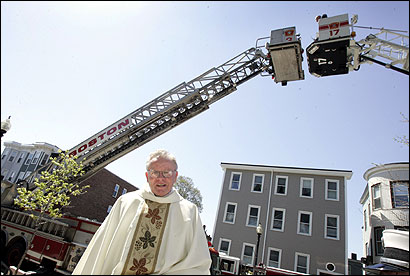
Yesterday's mass was phenomenal!!!! The church was packed. I was so happy for him. The service was beautiful. The bagpipes, the honor guard, the firefighters.

The Globe did a whole article on him that you can read here. You will see I am not the only one who loves and admires him.
My favorite stories are about the fire at the temple in Everett....Mahoney's best-known rescue was not of a person, but of the five Torah scrolls of Temple Tifereth Israel in Everett, which was destroyed by fire in 1982.
''The Torahs had to be saved," recalls Samuel Spivack, a member of the congregation who now lives in Salem, N.H. ''We had a young rabbi who wanted to go in and a few of us wanted to go in with him, but the fire department wouldn't hear of it."
Mahoney and others at the scene braved thick smoke to enter the sanctuary, and a backdraft knocked them to the ground as they reached the ark where the Torahs were kept. They got up, broke through windows near the ark, and threw the Torahs from the inferno to the waiting congregants.
Saving Mike Mucci's dad.........
"The young priest's first act of firefighter-like heroism came in 1959, when a house near the church was engulfed by flames from a natural gas line explosion. Nine-year-old Michael Mucci escaped the blazing home with his mother. Now Major Michael Mucci of the Massachusetts State Police recalls vividly how ''Father Mahoney broke through the back door, found my father wandering around dazed, and walked him out. . . . He saved my father's life."
and the bridge dedication story.....
"Mahoney almost missed the dedication, where access was tightly controlled due to the hosts of political leaders present and the hypersensitive post-9/11 security environment. The license number of the priest's fire department vehicle was not on the list being checked by the state trooper at the entrance to the bridge.
The trooper called his supervisor, Mike Mucci. ''Dan Mahoney?" said the son of the man Mahoney had saved a half-century earlier. ''He can park anywhere he wants."
His is my friend, my pastor and my hero.
Congratulations Father. I love you.
John Kenneth Galbraith

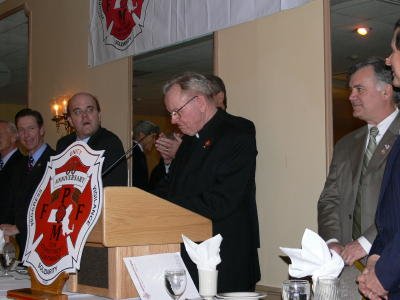
passed away this weekend. I was listening to NPR this weekend and they were playing an interview with him from several years ago and it was very interesting. What a life, working on the New Deal, advising President Kennedy. What am incredible life. What an amazing mind.
Subscribe to:
Posts (Atom)


